Deadly Dozen - Enterprise Fitness Platform for 17,000+ Athletes
Eight interconnected production systems - AI chatbot, live race judging, championship qualifications, real-time leaderboards, admin analytics, and more - powering a global fitness competition across 23 countries.
17,000+Athletes Worldwide
23+Countries
8Production Systems
<1sPage Load Times
What We Built
Eight interconnected production systems powering competitive fitness worldwide
Athlete Platform
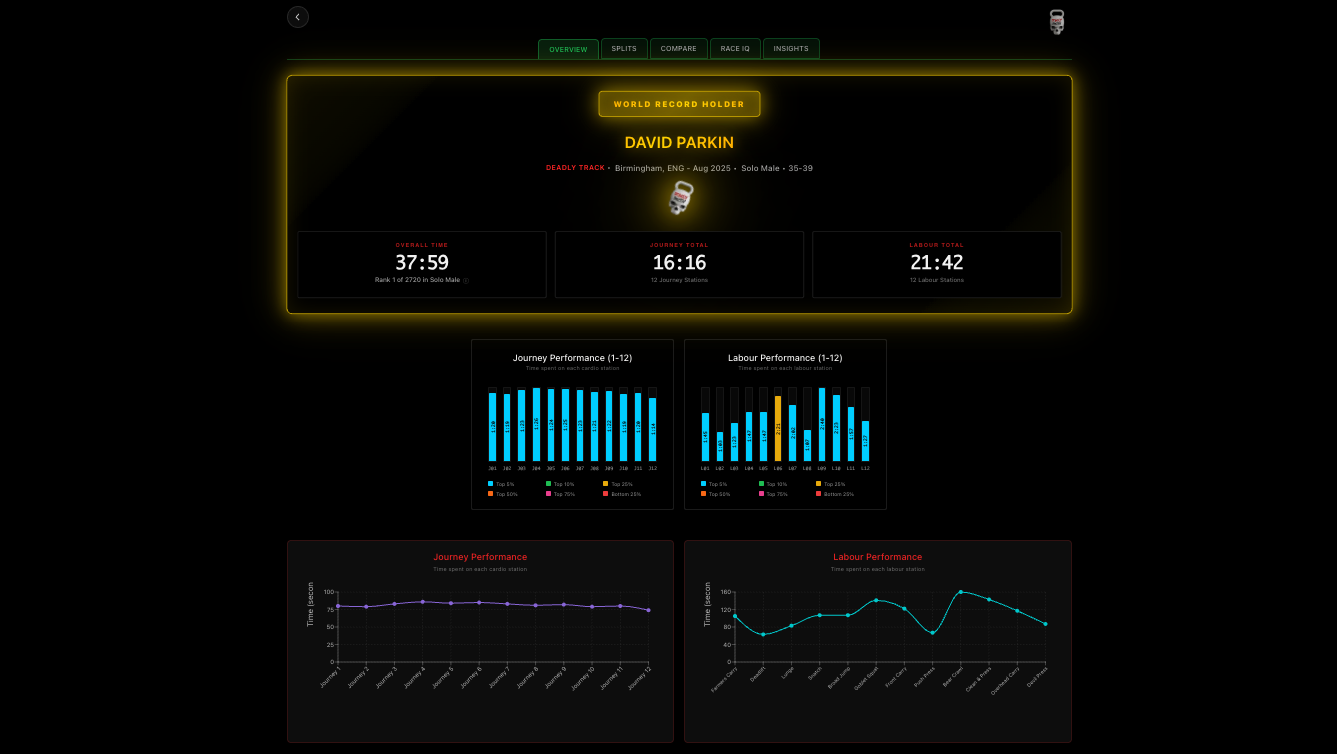
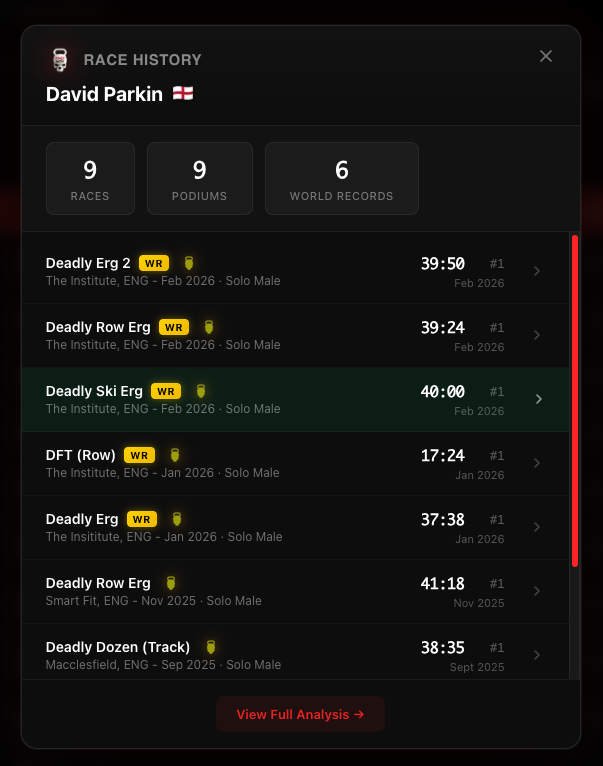
The competition hub where 17,000+ athletes register, submit scores, track rankings, and manage their entire competitive journey on any device.
Leaderboard Engine
Real-time rankings powered by PostgreSQL materialised views, updating across every category and division within milliseconds of a score submission.
Championship System
Sophisticated qualification engine using window functions and recursive CTEs to calculate multi-event standings and dynamic qualification thresholds.
Race Calendar
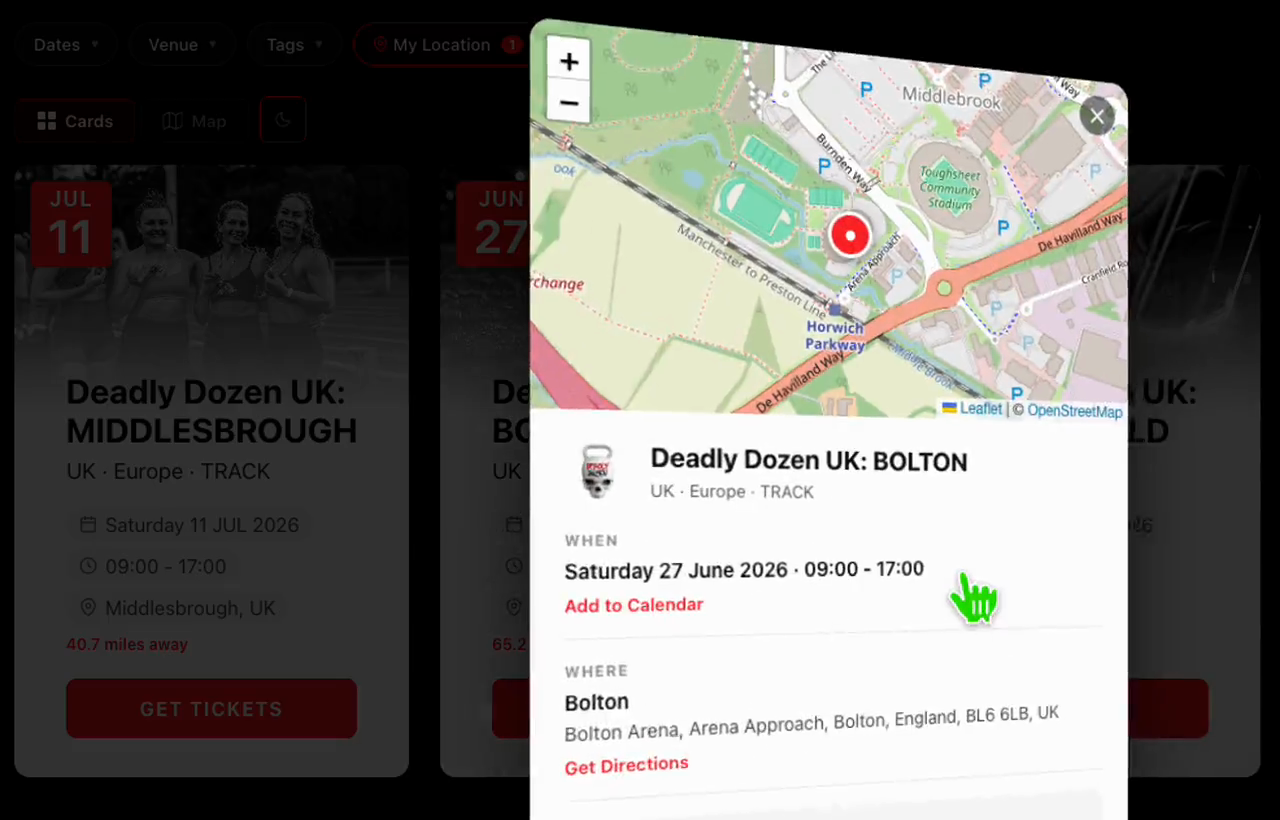
Unified event management with registration, payment processing, capacity limits, waitlists, and automatic iCal sync to athletes' personal calendars.
Judge Scoring App
Tablet-optimised live scoring for in-person events with QR check-in, instant leaderboard updates, and real-time venue display integration.
HAI Mobile App
Cross-platform native app built with Expo that calculates a composite fitness index, detects training bias, and classifies athletes into performance tiers.
AI Chatbot
Claude-powered assistant with nine custom database tools that answers personalised questions using live athlete data, scores, and qualification status.
Admin Dashboard
Full command centre with real-time analytics, competition configuration, score moderation, revenue tracking, and role-based access control.
The Brief: A Global Fitness Empire That Outgrew Every Tool It Tried
Deadly Dozen is one of the fastest-growing fitness competition brands in the world. Athletes across twenty-three countries compete in twelve brutally demanding workouts, with real-time rankings, championship qualifications, and live events creating year-round engagement. When they came to us, their community of over seventeen thousand athletes was thriving - but the technology behind it was on the verge of collapse.
Their stack was a graveyard of workarounds: leaderboards maintained in Google Sheets, event registrations arriving via email, championship qualifications tracked on whiteboards, and an admin team burning weekends to manually publish results. Athletes were refreshing pages that never updated. Judges at live events were scoring on paper. There was no analytics, no automation, no way to scale. For a brand with global ambitions, this was not just inconvenient - it was an existential bottleneck.
The brief was staggeringly ambitious. Deadly Dozen did not need an app. They needed an entire ecosystem: real-time leaderboards that update the instant a score lands, a championship qualification engine with complex multi-event scoring, a race calendar with registration and payment processing, a live race judge app for in-person events, an AI-powered chatbot that could answer athlete questions by reading the entire database, an extensive admin dashboard with deep analytics, a performance tracking tool for year-round training, a barbell simulator, and a badge system to drive engagement between competitions. All of it had to load in under one second for athletes on mobile networks in rural Australia. All of it had to feel effortless.
We took the project on as a full product engineering engagement - owning architecture, design, development, AI integration, deployment, and ongoing evolution. What we delivered is, we believe, one of the most technically sophisticated fitness platforms ever built.
Our Approach: Eight Systems, One Architecture
This was not a project that could be hacked together with off-the-shelf tools. The sheer breadth of functionality - athlete-facing apps, judge-facing tools, admin dashboards, AI systems, real-time data pipelines - demanded an architecture that could scale both in users and in capability without collapsing under its own weight.
We designed the entire platform as a monorepo powered by Turborepo, with seven distinct systems sharing a common data layer, design system, and authentication infrastructure. Shared components - buttons, forms, navigation, data-fetching hooks, real-time subscription wrappers, authentication flows - live in internal packages consumed by every application. When we optimise a leaderboard component in the main platform, that improvement instantly propagates to every other system. When a Supabase query utility gets faster, every app benefits without a single copy-paste.
The frontend runs Next.js 15 with React 19, TypeScript, and Tailwind CSS 4. TypeScript was non-negotiable - with interconnected systems sharing types, database schemas, and utility functions, type safety prevented entire categories of bugs. Tailwind CSS 4 gave us rapid, consistent styling while keeping bundle sizes lean enough to hit that sub-second load target. State management uses Zustand for its minimal footprint, Radix UI provides accessible component primitives, and Recharts powers the analytics visualisations across the admin dashboard.
The backend is Supabase on PostgreSQL - a managed database with real-time subscriptions, row-level security, built-in auth, an auto-generated REST API, and edge functions for server-side logic. PostgreSQL's mature indexing, window functions, materialized views, and JSON support meant we could power complex leaderboard calculations, championship qualification engines, and AI-readable data structures without reaching for additional databases.
For AI capabilities, we integrated Claude as the intelligence layer behind the chatbot, with a custom retrieval system that reads directly from the live PostgreSQL database - giving athletes instant, accurate answers about their scores, rankings, upcoming events, and qualification status.
Every system deploys to Vercel's edge network. Preview deployments on every pull request, edge distribution for global performance, instant rollbacks, and seamless GitHub integration. The entire CI/CD pipeline runs through Turborepo with remote caching - unchanged packages never rebuild.
What We Built: The Complete Platform
1. The Athlete Platform - Competition Hub
The core application is the beating heart of Deadly Dozen. This is where athletes register, build profiles, enter competitions, submit scores, watch their leaderboard position update in real time, earn badges, and track their journey across championships. We designed every interaction to work flawlessly on mobile - because most athletes access the platform from their phones, often mid-workout with chalk-covered hands.
The registration flow handles profile creation, category selection (age, gender, experience level), team affiliation, and payment processing for premium competitions. Returning athletes land on a personalised dashboard that surfaces their current ranking, championship qualification status, upcoming events, recent badge unlocks, and a feed of activity from athletes they follow.
2. Real-Time Leaderboard Engine
The leaderboard system is the technical centrepiece of the entire platform, and we engineered it to be bulletproof. At its core is a PostgreSQL materialized view that pre-computes rankings across every category, division, and championship tier. When an athlete submits a score, a database trigger refreshes the materialized view, and Supabase's real-time engine broadcasts the change to every connected client viewing that leaderboard segment. The update is visible within milliseconds.
We designed the engine to handle edge cases that would break simpler implementations: tied scores with cascading tiebreaker rules based on bodyweight and submission time, retroactive score adjustments by administrators that ripple through every dependent ranking, multi-event aggregate scoring where an athlete's championship position depends on performance across all twelve workouts, and mid-competition division transfers. With over seventeen thousand athletes submitting scores simultaneously during peak competition windows, the leaderboard had to handle complex multi-column sorting, real-time updates, stable pagination even as rankings shift, and filtering by country, division, age group, and team - all without a single loading spinner.
We implemented an optimistic UI pattern where score submissions update the local leaderboard instantly, then reconcile with the server. Athletes see their new ranking the moment they hit submit. That immediacy is what makes the platform feel alive.
3. Championship Qualification System
Championships are the pinnacle of the Deadly Dozen calendar, and the qualification system we built is extraordinarily sophisticated. Athletes qualify based on aggregate performance across multiple competition cycles, with different qualification thresholds for each championship tier. The system tracks qualification progress in real time, showing athletes exactly what scores they need across remaining workouts to secure their spot.
The qualification engine uses PostgreSQL window functions and recursive common table expressions to calculate standings across overlapping competition periods, weighted scoring categories, and division-specific thresholds. When a new score is submitted, the system recalculates not just that athlete's qualification status, but the cascade effect on every other athlete in the same qualification bracket. An athlete who was safely qualified might drop below the threshold because a competitor just posted a better score - and both athletes see that change reflected instantly.
Administrators can configure championship rules - qualification criteria, entry caps, wildcard allocations, and seeding algorithms - through the admin dashboard without touching code. This flexibility means Deadly Dozen can launch new championship formats without a development cycle.
4. Race Calendar and Event Management
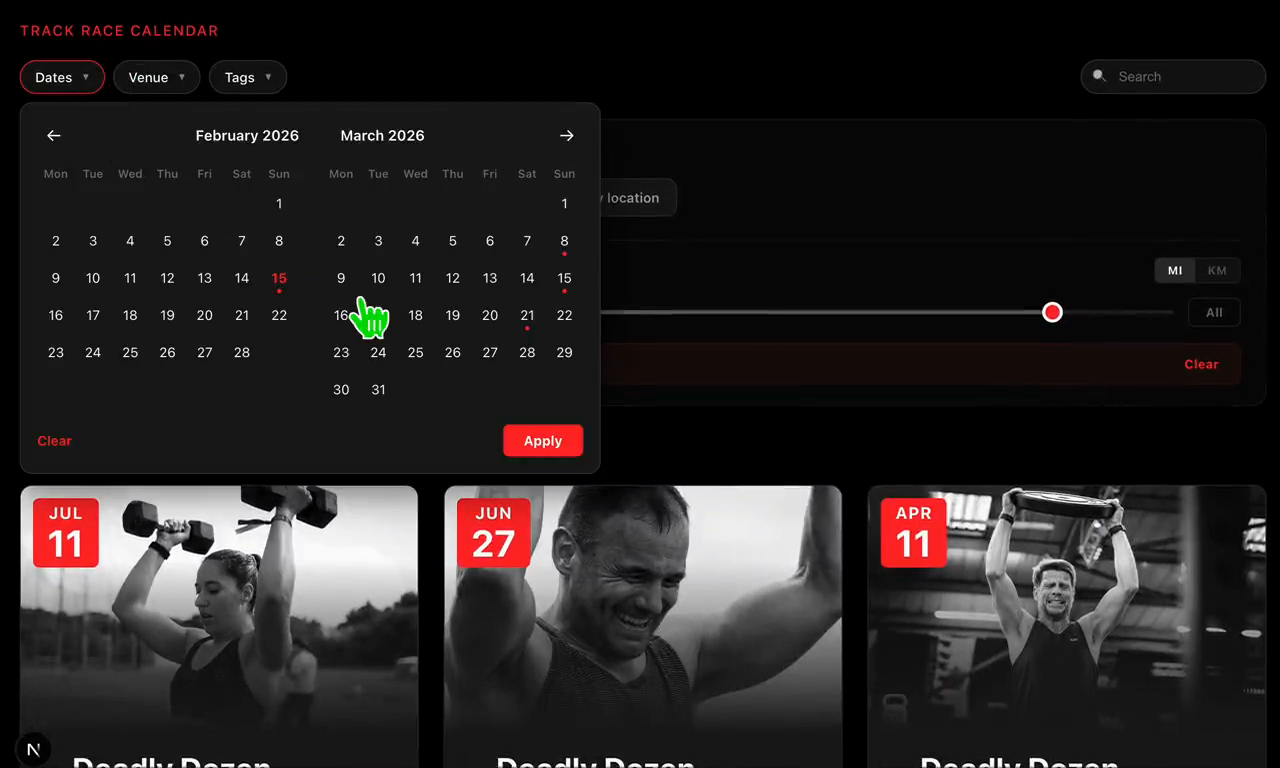
The race calendar is the central nervous system that connects everything - competitions, in-person events, championship qualifiers, community meetups, and workout deadlines. We built a fully interactive calendar that athletes can browse, filter by event type and location, and register for events directly from the interface. iCal export integration means events and deadlines sync automatically to athletes' personal calendars on any device.
Each event type has a distinct registration flow, pricing structure, scoring mechanism, and results display. Virtual competitions accept remote score submissions with video verification. In-person events integrate with the live judge app for real-time scoring at the venue. Championship qualifiers automatically feed into the qualification engine. The system handles capacity limits, waitlists, early-bird pricing, team registrations, and refund processing - all from a single unified platform.
5. Live Race Judge App
This was one of the most impactful systems we built. At in-person Deadly Dozen events, judges previously scored athletes on paper, then someone manually entered the results into a spreadsheet hours later. Errors were common, delays were frustrating, and athletes had no idea how they performed until the next day.
We built a dedicated judge app - optimised for tablet use at the venue - that transforms the entire live event experience. Athletes check in by scanning a QR code from their profile. Judges see the athlete's details, division, and event assignments on screen. As each workout is completed, judges enter scores directly into the platform using a purpose-built interface with large touch targets, smart input validation, and confirmation dialogs to prevent fat-finger errors.
The results are live. The moment a judge confirms a score, it flows into the leaderboard engine, updates the athlete's championship qualification status, triggers any earned badges, and appears on the venue's display screens. Athletes standing in the gym can watch their ranking change in real time. The energy this creates at live events is transformative - athletes finish a workout, look up at the screen, and see exactly where they stand. It turned what used to be a disconnected scoring process into a spectator-grade live experience.
6. HAI - Hybrid Athlete Index
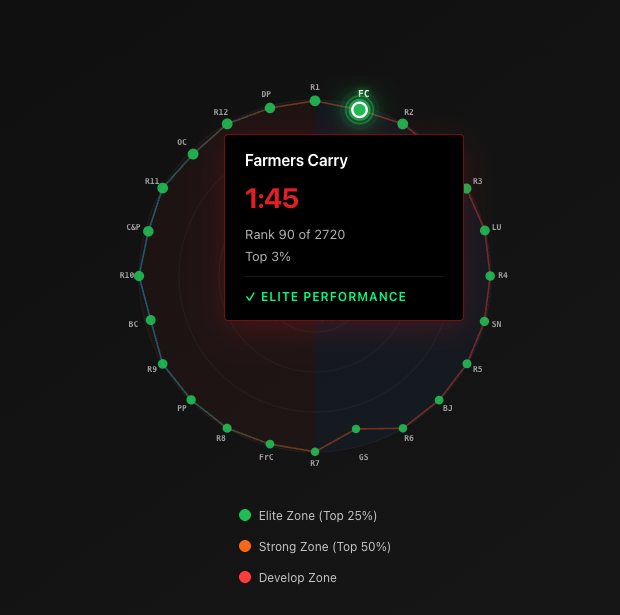
HAI (Hybrid Athlete Index) is a native mobile app we built with Expo and React Native that gives athletes a comprehensive fitness score beyond competition rankings. HAI calculates a composite index from test results across multiple disciplines, classifies athletes into performance tiers, detects training bias (whether an athlete skews toward running or strength), and generates personalised insights and recommendations. It is a year-round training companion that helps athletes understand their overall fitness profile and identify areas for improvement.
The app features tier-based athlete classification, bias detection algorithms, a progress tracker with historical trends, and sharing functionality so athletes can compare their HAI scores socially. Built as a cross-platform native app, it runs on both iOS and Android from a single codebase within the monorepo.
7. Intelligent AI Chatbot
The AI-powered chatbot we built into the platform is far more than a FAQ bot. It reads the live database. It knows every athlete's scores, rankings, qualification status, upcoming events, and competition history - in real time. Athletes can ask natural-language questions and get instant, accurate, personalised answers.
"What score do I need on workout 8 to qualify for the World Championship?" - The chatbot calculates the exact threshold based on the athlete's current aggregate, the qualification cutoff, and the remaining events.
"How do I compare to the top 10 in my division?" - It pulls the division leaderboard, computes the gap for each workout, and identifies the athlete's strongest and weakest performances.
"When is the next event near me?" - It queries the race calendar, filters by location, and surfaces the closest upcoming events with registration links.
Under the hood, the chatbot uses Claude as its reasoning engine with nine custom tools that query the PostgreSQL database directly - world records lookup, athlete search, leaderboard queries, statistics, upcoming races, race event search, website fetch, lead capture, and escalation to human support. We built a structured tool-use system where Claude calls the right database function for each question - no hallucination, no stale data, no generic responses. Every answer is grounded in live platform data. It includes conversation logging, rate limiting, abuse detection, IP blocking, and a full admin interface for managing the knowledge base and monitoring conversations.
AI-Voiced Holographic Race Cards
Every race result generates a personalised holographic race card - a dynamic, animated card that showcases the athlete's performance with a custom AI-generated voice narration. Winners and podium-placed athletes receive cards that celebrate their achievements, but we did not stop there. Every single athlete who completes a race gets their own card, because finishing a Deadly Dozen race is an achievement worth celebrating.
The AI voice system generates unique narration for each card, highlighting the athlete's time, ranking, personal bests, and standout moments from their race. The holographic visual treatment gives each card a premium, collectible feel - something athletes are proud to share on social media and keep as a record of their competitive journey. It is one of those features that turns a data point into an emotional moment, and it has become one of the most shared pieces of content across the Deadly Dozen community.
8. The Admin Dashboard - Command Centre
Behind every athlete-facing feature is an admin dashboard that gives Deadly Dozen's team complete visibility and control over the entire platform. We built this as the nerve centre of the operation - a comprehensive analytics and management tool that replaced their spreadsheet-and-email workflow entirely.
The analytics suite provides real-time metrics on athlete registrations, competition participation rates, revenue, event capacity, geographic distribution, retention cohorts, and engagement trends. Custom date ranges, exportable reports, and drill-down capabilities mean the team can answer any business question without writing a database query. We built interactive charts and data visualisations that surface insights at a glance: which workouts drive the most engagement, which countries are growing fastest, where athlete drop-off occurs in the competition funnel, and how championship qualification drives retention.
On the management side, administrators can configure competitions, set qualification rules, manage event logistics, process refunds, moderate score submissions, adjust leaderboard entries, create and manage badge criteria, publish announcements, and control every aspect of the platform through an intuitive interface. Role-based access control means event organisers see only what they need, while the core team has full platform visibility.
The dashboard also integrates with the AI chatbot logs, giving the team insight into what athletes are asking about most - a goldmine for prioritising feature development and identifying pain points.
RaceIQ Performance Tracker
RaceIQ is a standalone performance tracking application that athletes use year-round. It allows users to log workouts, track personal records, analyse performance trends over time, and compare metrics against division averages. We built it as a separate application within the monorepo because its user experience is fundamentally different - a daily training tool rather than a periodic competition interface.
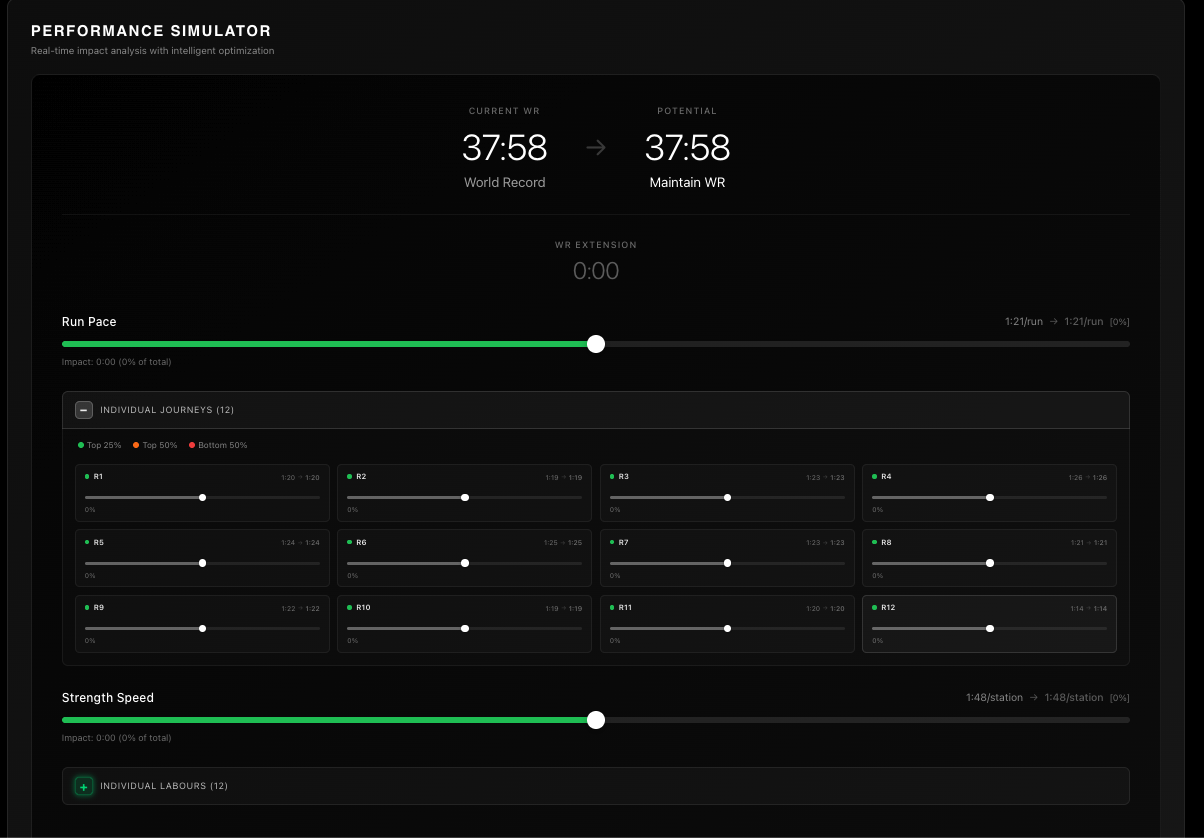
The analytics engine processes historical workout data to surface strength progression curves, volume load tracking, estimated one-rep maxes from sub-maximal sets, and performance plateaus. All calculations happen client-side using shared utility functions - instant analytics, zero loading spinners. Data sync between RaceIQ and the main platform is seamless and bidirectional, powered by Supabase's real-time subscriptions.
Barbell Simulator
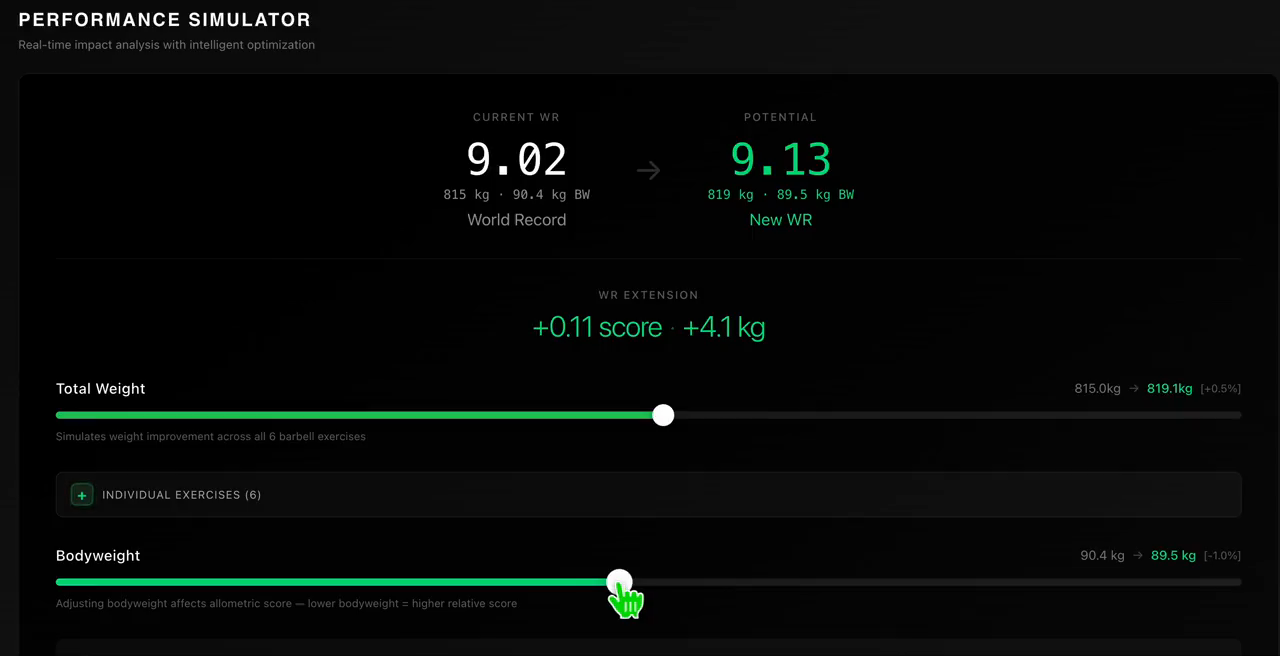
The Barbell Simulator is the most visually distinctive piece of the platform. It provides an interactive SVG visualisation of a barbell being loaded with plates - accounting for different bar types, varying plate inventories, metric and imperial conversion, and plate dimensions that follow international weightlifting federation standards. Smooth animations, crisp rendering at any screen size, and an intuitive drag interface made it an unexpected viral hit. Athletes shared screenshots on social media, driving organic traffic to the platform.
Technical Deep Dive: The Engineering Behind It
Four-Layer Caching Architecture
Sub-second load times for eight data-heavy systems serving a global audience required a caching architecture with zero room for error. We implemented four layers that work in concert.
Layer 1: Vercel's Edge Network. Static assets and pre-rendered pages serve from the edge node nearest the user. An athlete in Sydney hits an Australian data centre, not a European one. Layer 2: Database query caching. Supabase caches frequently accessed data - leaderboards, event listings, badge definitions - with intelligent invalidation when underlying data changes. Layer 3: Application-level caching via TanStack Query with stale-while-revalidate patterns. Leaderboard pages load instantly from cache, then silently update if rankings have changed. No spinners, no content jumps. Layer 4: Service worker pre-caching. Returning visitors experience near-instant loads from the browser's own cache.
The result: median page load time across all eight systems sits below one second, even on slower mobile connections in regions far from primary infrastructure.
Badge and Achievement System
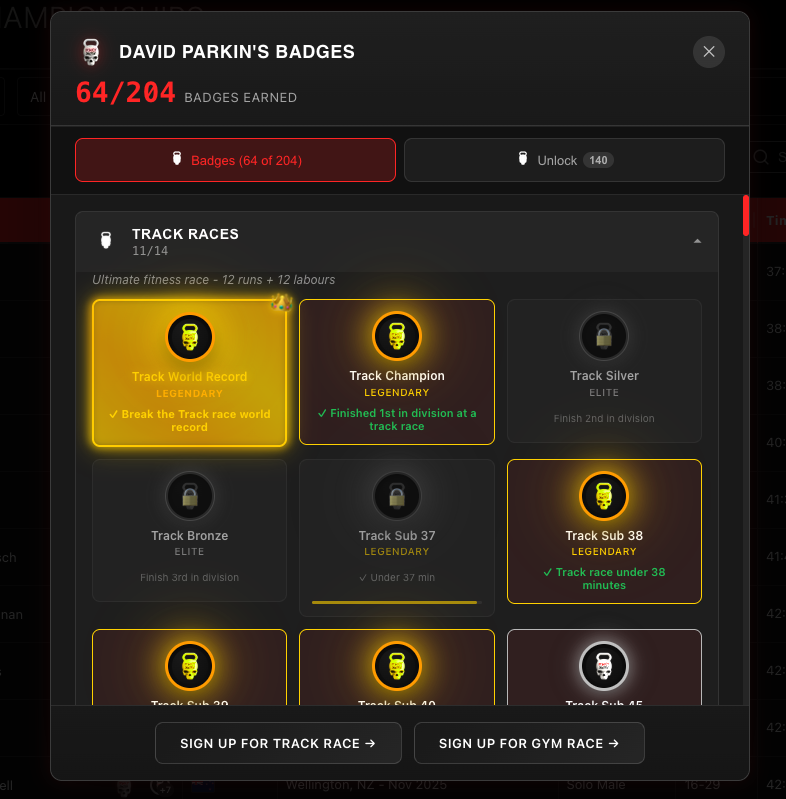
The gamification layer uses event-driven architecture. PostgreSQL triggers evaluate actions - score submissions, personal records, competition completions, championship qualifications - against badge criteria stored as JSON configurations. New badges can be created through the admin dashboard without deploying code. Notifications arrive in real time via Supabase's presence channels, giving athletes the rush of an instant unlock the moment they qualify.
The platform launched ahead of the next competition cycle, and the transformation was immediate and dramatic.
Leaderboard updates that took hours of manual work now happen in milliseconds. Event registrations that arrived as tangled email threads flow through a structured system with automatic confirmation, payment processing, and calendar sync. Championship qualifications that lived on whiteboards are now tracked in real time with push notifications. Live events that relied on paper scoring now produce instant results that athletes watch update on screens while still in the gym. And the AI chatbot handles hundreds of athlete questions daily that previously hit the admin team's inbox.
The numbers are striking. Leaderboard page load time dropped from over eight seconds to under one second. Event registration completion rates surged after we replaced a clunky third-party form with a streamlined, mobile-first flow. Daily active users during non-competition periods - historically near zero - climbed substantially as athletes adopted RaceIQ and the badge system. The admin team went from spending entire weekends processing competition data to having results published automatically within minutes of the final deadline.
But the number that matters most is this: Deadly Dozen's athlete base has continued to grow since launch, with the platform now serving competitors across twenty-three countries. The architecture we engineered from the start - modular, type-safe, AI-augmented, and built on managed infrastructure - means the platform can scale to ten times its current user base without a fundamental re-architecture.
That is the difference between building software that solves today's problem and engineering a platform that grows with the business. This is what we do.
The platform is built with Next.js 15 and React 19 on the frontend, styled with Tailwind CSS 4, and powered by Supabase (PostgreSQL) on the backend. The HAI mobile app uses Expo and React Native for cross-platform iOS and Android. All systems live in a Turborepo monorepo with remote caching and deploy to Vercel's edge network across three environments (testing, staging, production). The AI chatbot uses Claude with nine custom database tools. State management uses Zustand, UI components use Radix UI, and analytics visualisations use Recharts. Real-time features use Supabase's subscription engine, and performance is optimised through a four-layer caching architecture spanning edge caching, database query caching, TanStack Query stale-while-revalidate patterns, and service worker pre-caching.
The AI chatbot uses Claude as its reasoning engine with nine custom tools that query the live PostgreSQL database directly - world records lookup, athlete search, leaderboard queries, statistics, upcoming races, race event search, website fetch, lead capture, and escalation to human support. It translates natural-language questions into precise database lookups, so every answer is grounded in real-time platform data - athlete scores, rankings, qualification status, events, and more. There is no hallucination and no stale data. The system includes conversation logging, rate limiting, abuse detection, and a full admin interface for managing the knowledge base. Athletes can ask questions like "What score do I need to qualify for the European Championship?" and get an accurate, personalised calculation in seconds.
Athletes check in by scanning a QR code from their profile. Judges use a tablet-optimised interface with large touch targets and smart validation to enter scores in real time. The moment a score is confirmed, it flows into the leaderboard engine, updates championship qualifications, triggers any earned badges, and appears on venue display screens. Athletes can watch their ranking change live while still in the gym - turning what used to be a paper-based process into a spectator-grade experience.
Absolutely. We specialise in engineering production-grade platforms for businesses that have outgrown off-the-shelf tools. Whether you need real-time leaderboards, AI-powered features, event management, admin analytics, or a combination of custom systems, we can architect and deliver a platform tailored to your requirements. Get in touch for a free consultation - we will scope the work and give you an honest assessment of timelines and costs.
Ready to Build Something Like This?
We build production-grade platforms for ambitious businesses. Tell us about your project and we will show you what is possible.